
Reviewed · DUBLIN WALKING TOURS
A Self Guided Walking Tour of Dublin’s Docklands
Docklands tells Dublin’s story in footsteps. I like that this tour lets you explore at your own pace with an audio guide and offline maps and sound. You also get a riverfront route that keeps pulling you toward the big sights, instead of turning the walk into random wandering.
One catch: you’ll need your own smartphone and headphones, since they’re not included. Also, it’s about an hour long, so wear shoes you can walk in comfortably.
Key Highlights You’ll Feel During the Walk

- Offline audio and maps mean you can keep going without burning mobile data
- Local-insider narration focuses your attention on what you’re actually passing
- A logical riverside route ties together maritime history, workers’ rights, and modern Dublin
- Major transport landmarks show how this area connects the city today
- Bridge and canal crossings keep the scenery changing as the story moves forward
First Steps at the Custom House in Dublin 1
Your walk starts at the Custom House on North Wall, Dublin 1. This is a smart opening choice because the building is tied directly to the story of Irish trade and commerce, and you’re already in the right frame of mind for what comes next.
If you want this to feel easy, set yourself up before you begin. Once you’re at the starting point, follow the directions so the audio starts when you’re in place. The tour is in English, and it’s designed to work like a guided walk without you needing to keep checking your phone every few seconds.
You can also read our reviews of more guided tours in Dublin



Why Docklands History Makes the City Feel Real
This route doesn’t treat Docklands like a theme park. It treats it like a working part of Dublin that has changed over time, from maritime industry to offices, events, and everyday transit.
As you walk, you’ll hear why the riverfront mattered: trade, ship traffic, engineering, and the people whose work shaped the port. You’ll also pick up the darker parts of the story through commemorations, so the walk lands with meaning instead of just pretty views.
Price and Timing, and What You’re Buying
This experience costs $11.99 per person and runs about 50 minutes to 1 hour 10 minutes. For a self-guided audio tour, that price makes sense if you’ll actually use it for its intended length and take your time at the key stops.
You’re not paying for a live guide who stays with your group for the full hour. You’re paying for a planned walking narrative, plus the practical value of offline access and repeat listening. That matters because the Docklands area is spread out enough that a “just walk around” plan can turn into backtracking. This keeps you moving in a sensible line.
Custom House to the Quayside: Trade, Commerce, and Built for Shipping
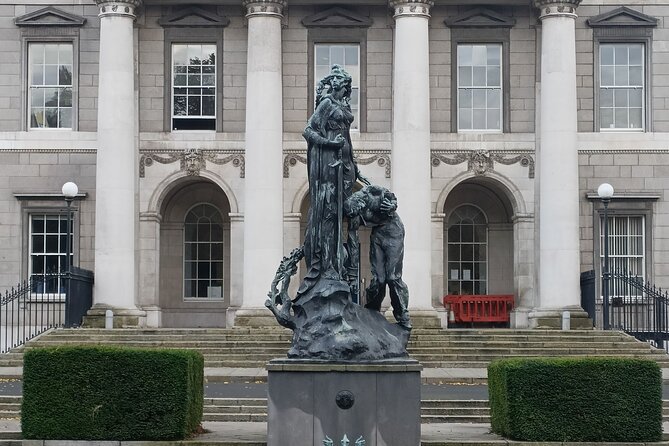
Right after the start, your audio focus lands on the Custom House, described as a stunning neoclassical building and a former center of Irish trade and commerce. Even if you only catch parts of it from the sidewalk, it works as a “why you are here” anchor.
From there, you follow the quayside, with a mix of historic warehouses and modern developments. That contrast is the whole point of the Docklands story. As you pass warehouses, you’re essentially seeing earlier layers of the port that once supported maritime traffic, and then noticing how the same shoreline became useful for newer uses.
James Connolly and Liberty Hall: A Workers’ Rights Thread
Next you’ll encounter a memorial honoring James Connolly, a key figure in Ireland’s fight for independence and workers’ rights. It’s an emotional stop, but it doesn’t feel random. It turns the tour from “ships and buildings” into “people and politics,” which is how Docklands history becomes more than trivia.
A little later, you pass the Liberty Hall Theatre, tied to Dublin’s labor movement history. This is a good section to slow down for a minute, because labor history can get flattened when you only read about it. Hearing it while standing in the right area gives it context fast.
A few more Dublin tours and experiences worth a look


Busáras and Connolly Station: When the Port Becomes Transit
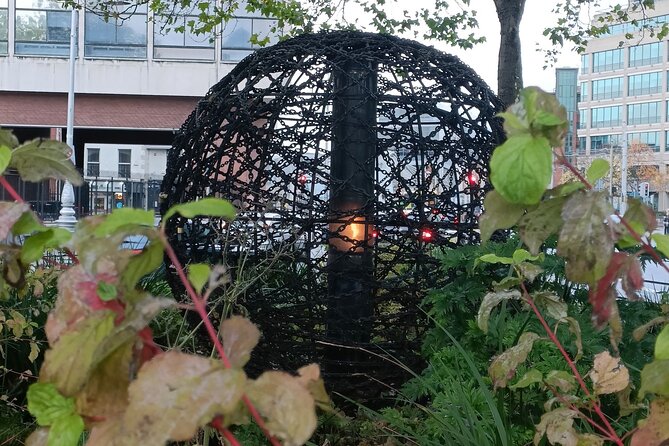
You’ll walk past Busáras, Dublin’s central bus station. Then you’ll see Connolly Train Station, one of the city’s main railway stations serving domestic and international routes.
These stops are valuable because they show the shift in how people and goods move. Docklands is no longer just about ships pulling into the harbor. It’s also about connections by bus and train, and the flow of people through major hubs.
IFSC and the Triumphal Arch: From Shipping Power to Financial Power
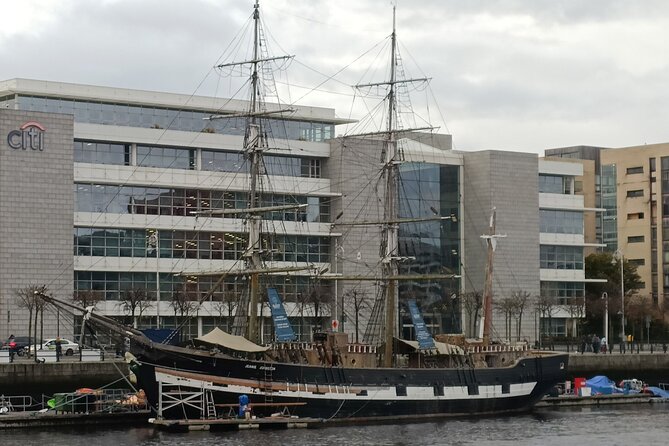
As you continue, the audio points you toward the IFSC, a major financial hub in Dublin with multinational corporations and financial institutions. Even if you don’t go inside anything, you’ll feel how the area’s economic role changed.
Then comes the Triumphal Arch, a historic monument commemorating Dublin’s maritime heritage and economic prosperity. This part works well if you like your history with a visual marker. An arch is easy to orient around, and it reminds you that economic power here was once tied to shipping long before finance took over the skyline.
The Scherzer Rolling Lift Bridges: Engineering You Can Still See
One of the most memorable technical stops is the Scherzer Rolling Lift Bridges. The narration highlights them as engineering marvels that once facilitated maritime traffic in the area.
This is where I think the audio style really helps. A lot of people walk past structures like this without realizing the job they were built to do. Here, you get the “why it mattered” in plain language, so you can actually look at the mechanisms instead of just moving on.
Famine Memorial and the Jeanie Johnston Replica: Where the Story Turns Somber
After the engineering and commerce clues, the tour turns serious with the Famine Memorial, a tribute to those who suffered during Ireland’s Great Famine in the 19th century.
Then you pass a memorial honoring Irish seafarers who lost their lives at sea. Together, these stops widen the story from the port itself to what the port connected to, including hardship and loss tied to travel and survival.
Next, you see a replica of The Jeanie Johnston, a historic ship that carried Irish emigrants to North America during the Great Famine. If you want a walk that teaches you something real without forcing museum time, this is that moment. The dock setting makes the emigration connection feel less abstract.
Seán O’Casey Bridge, Samuel Beckett Bridge, and River Views
Crossing the river via the Seán O’Casey Bridge gives you a classic Dublin Docklands payoff: skyline and waterfront views while you hear narration. It also helps break the walking rhythm, so you’re not stuck staring at the same side of the river for the whole tour.
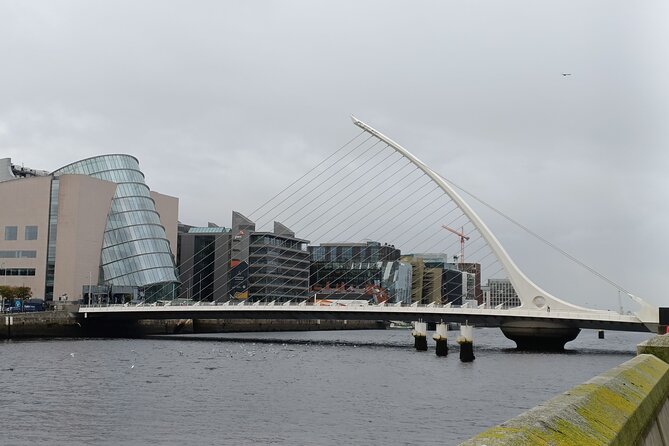
Later, you pass the Samuel Beckett Bridge, an iconic modern bridge named after the writer. The tour’s value here is that it times the modern structure after the older maritime story, so you feel the timeline shift from what the port used to be to what the city became.
Convention Centre Dublin and Admiral William Brown: Two Different Kinds of Dublin
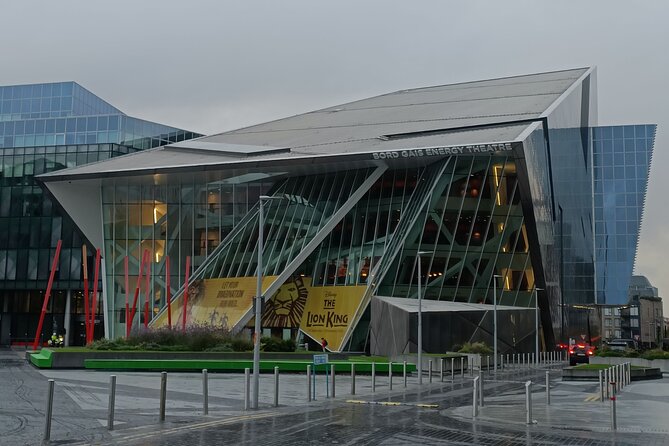
You’ll walk by the Convention Centre Dublin, which hosts conferences, events, and exhibitions. It signals how Docklands has become a place for public gatherings and international visitors, not just cargo.
Then you’ll see the statue of Admiral William Brown, an Irish-born naval officer who founded the Argentine Navy. That’s a great reminder that Dublin’s maritime influence reached far beyond Ireland. It’s also a nice visual punctuation point before you get into more port infrastructure details.
Diving Bell and the Sea Lock: The Port’s Hidden Machinery
The tour also points out a historic Diving Bell, once used for dock maintenance in Dublin’s bustling port. Even if you only catch it from the walkway, knowing it connects to maintenance makes it feel less like an odd curiosity and more like practical industrial history.
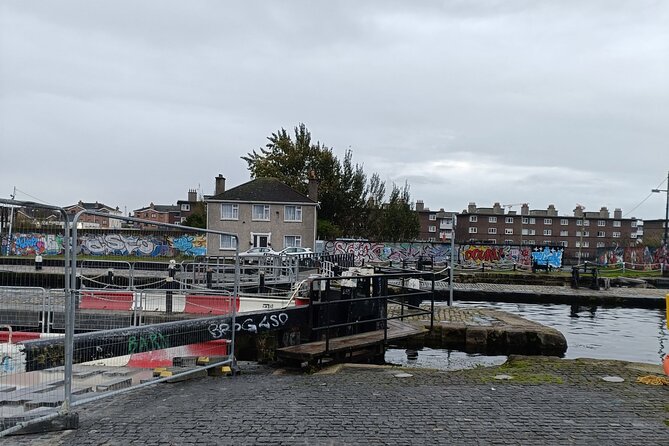
After that, you walk by the sea lock, described as a crucial component regulating water levels in the docks. This stop is one of the best examples of why the audio guide matters. You can see the structure, but the guide helps you understand what problem it solved.
Grand Canal Docks, Hanover Quay, and the Creative Side of Docklands
Toward the end, you’ll see the Grand Canal Docks sign, marking the entrance to Dublin’s historic canal basin. Then you pass Hanover Quay, a waterfront area with a mix of residential and commercial developments. This helps you connect the dock story to where people live and work now.
You’ll also walk by Hanover Quay Studios, a recording studio complex frequented by musicians and artists. That’s a surprisingly good way to end the maritime thread with something contemporary. It signals how the area keeps finding new uses for its spaces.
Finishing at Red Sticks Dublin and Grand Canal Square
The tour ends at Red Sticks Dublin on the Grand Canal, with the endpoint located near Grand Canal Square. This finishing area is a strong way to close the loop because the story has moved from trade and shipping to modern Dublin, and now you land in a public space where the city’s day-to-day energy shows.
If you want to keep the momentum going after the tour, treat this as your pause point. Use it to sit down, grab a drink nearby, and decide whether you want more time by the canal or to hop on transport.
Offline Access and Virtual Playback: Use It Your Way
A standout feature is offline access to audio, maps, and geodata. That’s a big deal in Dublin, where indoor time and roaming data can add up fast. With offline materials, you can stay on the route without constantly worrying about signal or battery.
You also get a virtual playback option, so you can listen like an audiobook from anywhere. That means you can review the story before your walk, or after, while you plan a return route. Plus, you receive unlimited, lifetime use of the tour before and after your booking date, which turns a one-time visit into a reusable guide.
Who This Walk Is Best For
I’d choose this audio walk if you want Dublin history without adding the stress of a live group schedule. It’s also a good fit if you like structure, because the route links landmark after landmark in a way that keeps you oriented.
You might especially enjoy it if you care about labor history, maritime engineering, or memorials. This walk gives those topics their own space, instead of glossing over them.
It’s less ideal if you hate tech on trips. You’ll need your smartphone and headphones, and you’ll be following an audio plan as you walk.
Should You Book This Dublin Docklands Audio Tour?
If you want an hour-long, self-guided Dublin Docklands story with offline maps and clear narration, I think this is an easy yes. The value is strong for the price because you’re not just paying for sound, you’re paying for a route that strings together Custom House, major transport nodes, maritime engineering like the Scherzer Rolling Lift Bridges, and memorials that add weight to the landscape.
Skip it only if you don’t want to use your own phone and headphones or if you prefer a fully live guide. If you’re comfortable walking and letting an audio guide do the talking, this is a practical way to see Docklands in a way that actually sticks.
FAQ
Where does the Dublin Docklands walking tour start and end?
The tour starts at the Custom House, North Wall, Dublin 1, and ends at Red Sticks Dublin in the Dublin Docklands on the Grand Canal.
How long does the self-guided walk take?
The experience runs about 50 minutes to 1 hour 10 minutes.
What language is the audio guide available in?
The tour narration is offered in English.
Do I need internet to use the tour?
No. You get offline access to the audio, maps, and geodata.
What do I need to bring with me?
You need your own smartphone and headphones.
Can I listen to the tour without walking the route?
Yes. There is a virtual playback option, so you can listen like an audiobook from anywhere.
Is this tour private?
Yes. It is listed as a private tour/activity, and only your group will participate.
How do I reach the Custom House meeting point by public transport?
You can reach it using public transportation such as Busáras, luas, bus stops, and the Tara Street DART station. The start point is also about a 10 minute walk from O’Connell Street and a 15 to 20 minute walk from College Green.
More Guided Tours in Dublin



More Tours in Dublin





More Tour Reviews in Dublin



Not for you? Here's more nearby things to do in Dublin we have reviewed


Dublin Walking Tours, compared.
 ★ 5.0Dublin Highlights and Hidden Gems Guided Walking TourFrom $296,020 reviews
 ★ 4.9Highlights and Hidden Gems Walking TourFrom $272,140 reviews
 ★ 5.01916 Rebellion Walking TourFrom $271,605 reviews
 ★ 5.090 Minute Dublin Walking tour and Sightseeing tipsFrom $21916 reviews
 ★ 5.02-Hour Historical Walking Tour from DublinFrom $22875 reviews
 ★ 4.7Historical 2-Hour Guided Walking Tour of DublinFrom $22865 reviews
 ★ 5.0Dublin Traditional Irish 3 Course Meal Walking Tour with LocalFrom $107755 reviews
 ★ 4.9Mythology, Folklore and Legends Walking TourFrom $27703 reviews
Browse the lists this tour appears in